

Jim Carry said, “I wish everybody to be rich so that they would know that’s not the answer”.
This could be over simplified view, but is it the correct one?
The world seems to be divided between the 2 ends. One says that money is important and the more the better. Other says that beyond a certain point adding more money doesn’t help.
But at a basic level, the least that money does is making our judgements better.
Imagine 2 graduates, X and Y, studying in a college. X is blessed with rich parents and Y not so much. Y’s parents have somehow managed to send him to college by spending considerable savings. Y has to find a job and support his parents. X on the other hand doesn’t have any obligations or responsibilities. Both of them are offered a job at company T which has terrible culture, questionable work with long workhours. Stress is high but the pay is decent.
One option for both of them is taking the job which would automatically mean that one cannot sit for other interviews. The other option is to decline the offer and wait for better profiles, at the expense of not landing a job at all. Who is more likely to accept the job offer.
We all know the answer.
This plays out at all levels. When you see daily laborers or your house help, we are quick to question why they don’t prioritize education of their kids? Do they never want to get out of their condition? But the right question to ask is, are they feeling secure enough to think of education at the 1st place?
Because if basic sustenance and day to day survival is at risk, will one take any decision in the interest of future self? How can you think of education which yield results after decades if you are unsure about your next month or day? This is called scarcity brain where the brain prioritizes the decision making for the short-term gains at the expense of future.
The more I read, the more it is clear to me that the best thing money can buy is a sense of security and freedom. Money is a tool to manage sustainability related worries. It helps you invest in health insurance so that you don’t lose sleep over what would happen if the health failed. If you have savings and enough cushion, you are free to walk away from the toxic job. You can invest your time in building community and friendships, or you can spend on your leisure.
At a national level, this is reflected in World Happiness Index. The countries that are ranked highly are not necessarily the richest. Costa Rica ranks 5, Mexico ranks 12 and US is at 25. There is a constant theme that emerges when we study the happiest countries. When the basics are taken care of, citizens can spend time more productively and/or leisurely. The citizens of highly ranked countries report more freedom to choose, have more faith in government with low perceived corruption, have free or subsidized education or healthcare. India ranks 116th by the way.
Money Vs. Wealth
There is a distinction between money and wealth and one leads to another but that’s not always the case. You can be earning a lot but just a job-loss away from sinking into debt. These people are still better off than those who earn less because if you are earning more, chances of savings and building wealth is a lot easier.
This wealth allows you to think long-term and the overall well-being. You secure your future through buying insurance, investing in mutual or index funds and having liquid emergency fund. And it allows you not having to worry about losing your sanity if something goes wrong. Is this happiness? Not sure. But does it lead to more peace and contentment? Without a doubt.
So if the best that money can buy is security, does more money make sense? Is it directly proportional to happiness?
What about earnings at higher level?
In 2008, Daniel Kahneman, whose book “Thinking Fast and Slow” you might have heard of, published a paper in which he concluded that Happiness increases with increase in income up to an average level of $75,000 dollars and then plateaus. So additional income beyond this point won’t make you happy.
It sounds quite right as we just established that once the sustenance is taken care of, money might have a small impact on happiness. Except that’s not quite true.
As per Killingsworth, another psychologist, the happiness rises with rising income without plateauing. In 2023, both of them came together with Barbara Mellersa to test and make sense of these contradictory claims.
Merging the conclusions of studies by Kahneman and Killingsworth, it was found that people who are least happy, the bottom 15 percentile (you can call these people inherently unhappy due to some trauma or their nature), get increasingly happier till a certain level of income and then their happiness plateaus. This is what Kahneman concluded but for the entire population in his 2008 study.
The population at the middle continue to report happiness with rising income at all levels. And for the top 20 percentiles, the most-happy group, an increase in income beyond a certain point leads to an even bigger acceleration of happiness.
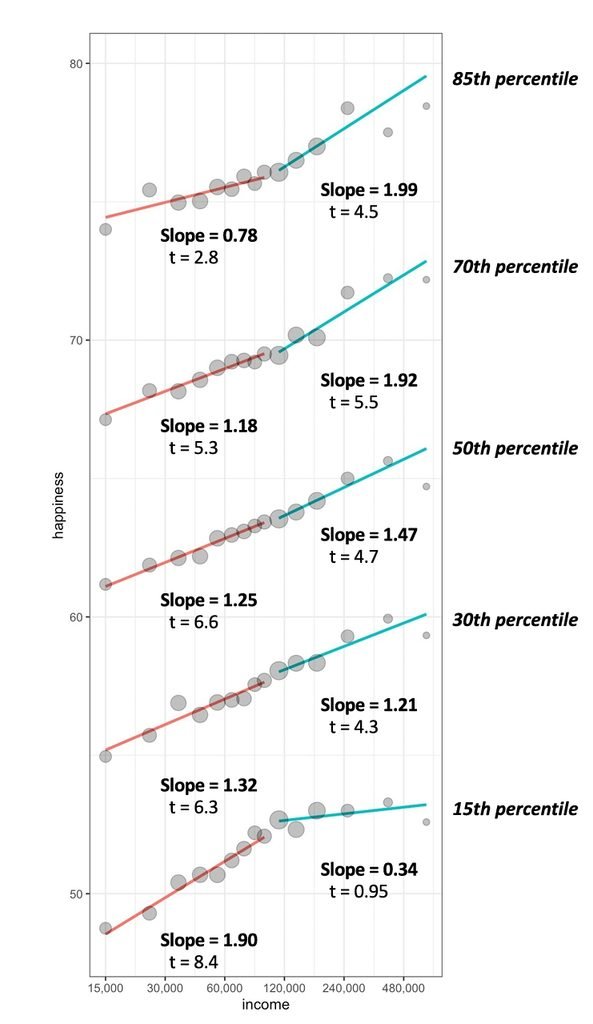
As it turned out, the study done by Kahneman in 2008 was a better judge of unhappiness than happiness. It means that with rising income the unhappiness goes down and at ascertain level, increase in income has no substantial impact on unhappiness. The study had a major flaw called ceiling effect, which we will discuss in the next article.
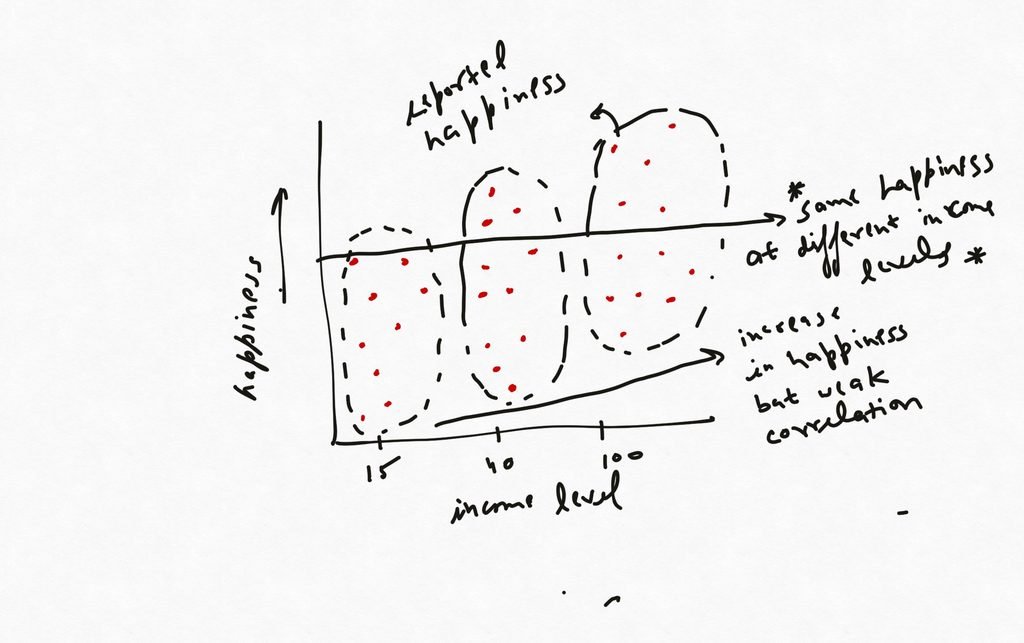
One point to note in the study is that the correlation between income and happiness is positive but low (0.09). It means that although increase in income positively impact happiness, but it doesn’t mean that income can predictably determine happiness. Variations in reported happiness can be huge within the same income group (with significant overlapping). The difference between the medians of happiness at household incomes of $15,000 and $250,000 is about five points on a 100-point scale. So naturally there are multiple other factors that lead to overall happiness. Money is one of them but not the dominant one.
Conclusion
Measuring happiness for research is a challenging task. Whatever limited research that has been done suggests that while money can have an impact on happiness, its effects are mild and other parameters may have larger effect. Think of health, social circle, supportive family, job stress.
When the sources are scarce, the predictable way to define how much money is enough is to observe. You will find people absolutely thriving with less, or unhappy people feeling miserable with more. The worthy questions to ask are “what’s enough” and “what’s would it cost to earn more?”
Find your enough and once that’s reached, strive towards maximizing the other aspects which are important for you such as fitness, nutrition, friendships, leisure. That’s what make a life well-lived.